
Program Dashboard allows viewing and editing all the information about a specific Program.
Program dashboard default sections
Summary section shows general information about the number of Projects by status, progress, and key dates.
Timeline section is represented by a progress bar that shows the overall progress of the Projects included in a specific Program.
If there are no start and/or finish dates for the Program, you will see the Dotted line in the timeline section. The logic of the dates displayed for the dotted line is the following:
- No start and finish dates - 1 month before today and 2 months after.
- If there is only a start date - 3 months after the start date
- If there is only a finish date - 3 months before the finish date
It is possible to configure Program sections, create a layout, and apply this layout to another Program. Please refer to the 'How to create and apply layouts' article.
You can also edit the name of each section and populate the description by clicking on the pencil-like button next to it. The sections can be expanded or hidden on the Program dashboard.

All sections can be opened in full-screen mode.

The Search option is available for multiple sections; it allows you to find the items you need quickly. For more details, please refer to the 'How to use the Search option' article.
By default, this page includes four sections: Statuses, Timeline, Projects, Key Dates, and Details. Optionally, the Budget, Action Items, Utilization, Risks, Strategic Alignment, Roadmap, Key Decisions, Change Requests, Issues, and other sections can be added.
Use the Share View option available on the right to share only the required information of the Program dashboard with the users. This functionality can help limit Program dashboard information for certain users.
Also, the Activity Log tracks changes, helping users audit updates and understand when and how data was modified.

Statuses section summarizes the overall statuses of the current Program. This section is also editable via its Configure menu. Two views are available here: cards and status history.

Click on the ellipsis button on the right side of the page to open the drop-down menu and choose Configure to open the Configure statuses menu. This menu allows hiding the unused status types by unchecking the corresponding checkboxes or rearranging their order (by clicking and dragging). Status categories can be customized as needed. You can add more statuses to each category, and rename the existing ones. For more details, please refer to the 'How to customize status categories for Projects/Programs/Portfolios/Tasks/etc' article.

The auto-calculation of the Program statuses is available in PPM Express. Auto-calculation of Program statuses is enabled by default, and the 'Allow to override status and description manually' option is on. It allows users to override the automatically calculated status and set the required status manually, and select the period of time for which the manually set status will be applied. After this period of time (3, 5, 7, 10 days) the status set manually will be overridden by the status calculated automatically. Users can also add/edit the status description. The administrator can change these settings on the PPM Insights page.
If the auto-calculation option is not enabled, all newly created Programs are created with N/A status, and then the status is updated by users as required.
To set the required value for each status, click on the status to open it for editing. The following values are available for each status: N/A, On Track, At Risk, Critical, and Done. Select the one you need, populate the description, and click the Update status button to save the changes.

Status History is available for each status. As the status information changes, status history shows who made the changes and what changes were made exactly. You can navigate to the Info option to see the details for the status changes.
Status History can be deleted if needed by users with Administrate app permissions, however, the latest update cannot be deleted. If the status history is deleted, it cannot be restored.

Projects section shows the list of all the Projects currently included in the Program and allows to manage them.
By default, the Timeline view is selected. If needed, you can switch to the Table view in the upper-right part of the Projects section.
Using the Configure Columns menu, you can configure the appearance of the Projects section by adding or hiding columns or changing their position (just drag and drop).

To navigate to the Project Details page of the required Project, click on a Project name in the list.
Use the Add Projects button to add a Project to the current Program.
Use the Create Project button to create a brand new Project within the current Program.
Select the Projects and use the Remove Projects button to remove Projects from the current Program.
Remove option is available from the Table view only.

Key Dates section displays key dates created in PPM Express. PPM Express allows to create 3 types of entities, which are:
- Milestones
- Release
- Key Date
Key date statuses are calculated automatically and will be set according to the key date's finish date, taking into account the current date:
- On Track – Finish Date is greater than or equal to Today;
- At Risk – The key date is late by less than 10 days (from Today);
- Critical – The key date is late by more than 10 days (from Today).
- Done - The key date is marked as Complete.
Timeline and table views are available for Key dates. By default, the timeline view is displayed, but you can switch to the table view at any time if needed.
Use the New key date button to create a key date. Also, Key Dates can be imported from your Projects using the Import Key Date button.
Use the Configure menu to configure the appearance of the Key Date section by adding or hiding columns. It is also possible to rearrange their order (by clicking and dragging).
You can add custom statuses to Key dates if you open the status field for editing. For more details, please refer to this article: How to customize status categories.

On the key date creation panel, select the key date type – a milestone, release, or key date. Enable the Show on Timeline checkbox to display the created milestone on the main progress bar in the Summary section of the Program page.
It is also possible to enable the Show on Timeline checkbox in the Key dates. For this purpose, select the Key date you would like to change information for, and click the Edit key date button.

The following statuses are available for key dates: N/A, On Track, At Risk, Critical, and Done.
To delete a key date, select the key date you would like to delete and click the Delete key date button.
The Baseline can be set for all PPM Express Key Dates. To set the baseline, select the Key Dates and click the Set Baseline button (the Baseline is created for the Date field).
If you open the Key Date for editing, the Baseline tab becomes active once all required fields are filled in. To remove the Baseline mark from the timeline view, click the 'Style' option and disable the Show Baseline option.

The Baseline will be read-only for rolled-up Key Dates (imported from Project or Program level). It is also possible to set the Baseline for the Key Dates imported from the external systems.
Details section includes the most important details about the Program: Program name, Description, Program status, start and finish dates, etc.
Using the Configure menu (ellipsis button, drop-down menu, in the right part of the section title bar), you can show or hide the fields set by default or even add your own custom fields.

Program dashboard optional sections
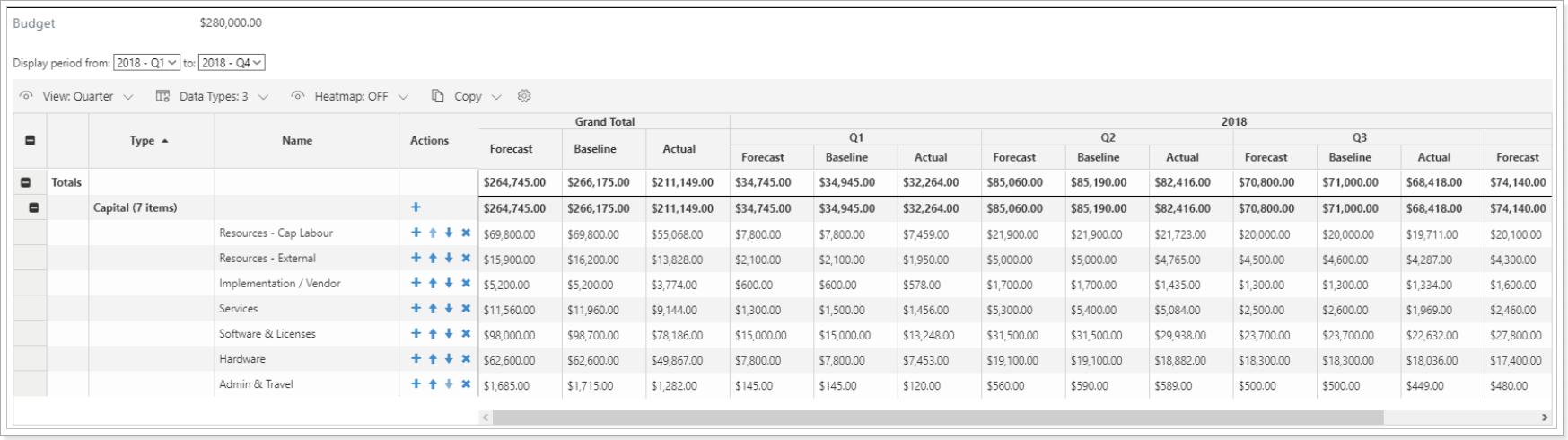
Budget section uses the Financials app, allowing you to edit the Program budget.
Viewing or editing budgets can only be done by users who have the Manage Financial Details permission enabled in their account settings.
You can find more on creating and editing a budget in the Managing budgets help article.
To change the currency for the PPM Express tenant, refer to this article for step-by-step instructions.
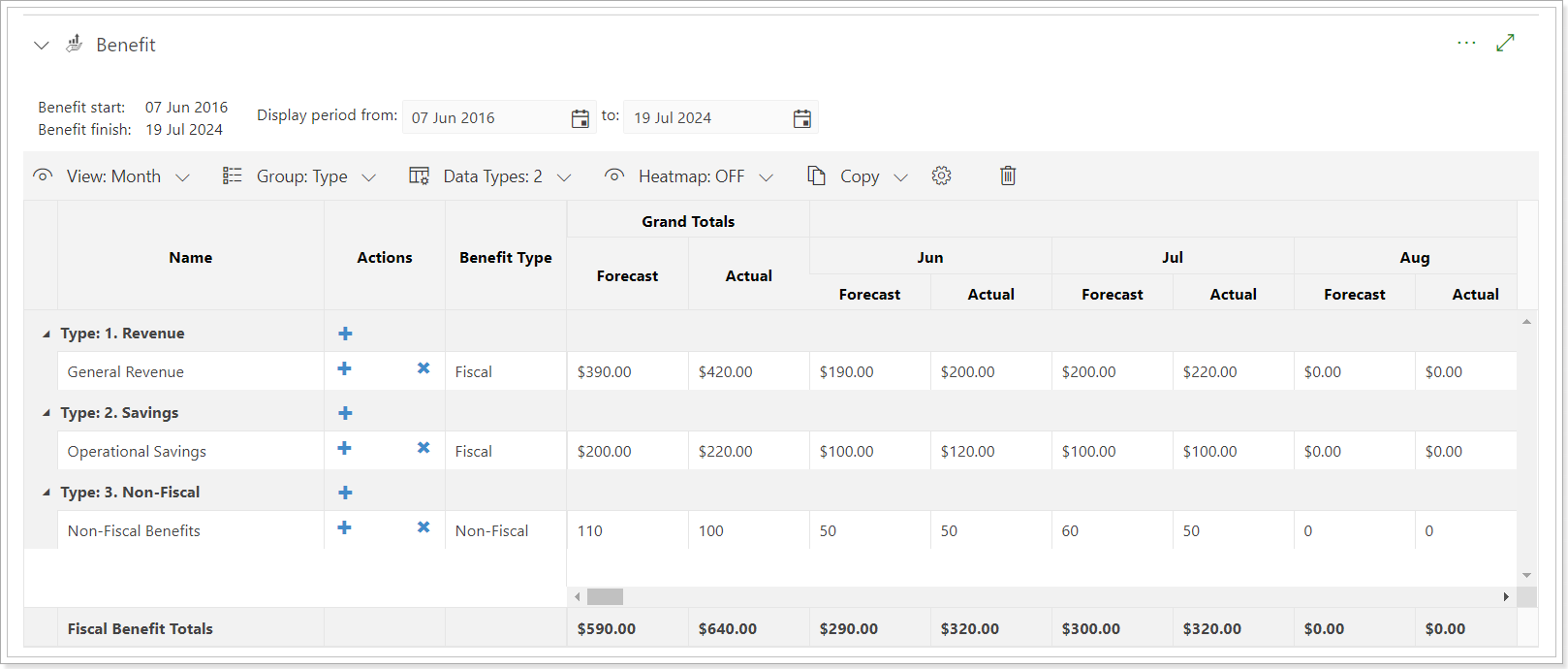
Benefits section is available for users with Manage Financial Details permission.
The Benefits Program section is similar to the Budget section and is configured via the Financials widget.
Two formula fields were added for this section to display data as needed: Estimated ROI and Estimated ROI Baseline.
- Estimated ROI = ((Benefits Forecast - Budget Forecast)/Budget Forecast) *100% (if at least one parameter is 0, the value will be 0)
- Estimated ROI Baseline = ((Benefits Forecast - Budget Baseline)/Budget Baseline) *100% (if at least one parameter is 0, the value will be 0)
Also, the Benefits Start/Finish date fields are available in the Program Details section and are hidden by default. There are two Benefit types: Fiscal and Non-fiscal.
The settings and fields are similar to the Budget section.
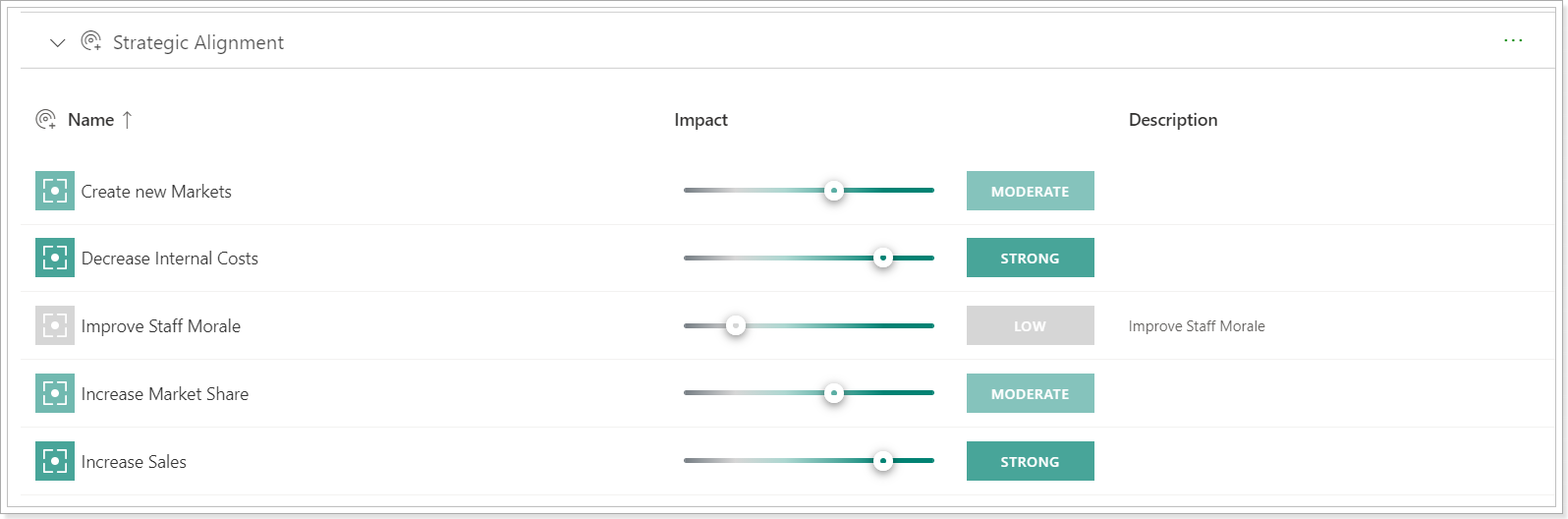
Strategic Alignment section shows all strategic priorities at the organization level that are added to the Strategic Priorities page. By default, the impact of the strategic priorities in this section is set to N/A.
Users who create and manage Programs can decide how organizational priorities impact the specific Program by setting the Impact of each priority in the Strategic Alignment section.
As the impact is set for each priority in the Strategic Alignment section on the Program dashboard, the Alignment Score field in the Details section is populated with the value. This value takes into account the Importance of the strategic priorities set on the Strategic Priorities page and the Impact set by the Program manager in the Strategic Alignment section. The percentage in the Alignment Score field shows Program compliance with company strategic priorities.
The higher the number in the Alignment Score field, the more the Program is consistent with the priorities of the company.
If there are any changes in the priorities on the Strategic Priorities page (changes in the Importance of the strategic priorities, new priorities added, the priorities are edited or deleted, the priority activated/deactivated), Program managers will see a message in the Strategic Alignment section as for the changes on the Strategic Priorities page.

If the Program manager clicks the Apply Changes button, the changes will be applied automatically, and the Alignments Score field will be recalculated according to the changes applied.
Risks section displays risks for your Program. Use the New Risk button to open the Risk edit menu.
Risks can be imported from your Projects to Programs using the Import Risk button.
The Configure Columns button is used to show or hide specific columns from the list or to add a custom field or rearrange their order (by clicking and dragging).

Risk Management functionality in PPM Express supports Inherited and Residual risks, helping you evaluate and compare risk levels before and after mitigation.
- Inherited Risk represents the original risk level, the probability, and impact before any actions or controls have been applied. It shows how severe the risk would be in its raw form.
- Residual Risk represents the remaining risk after you’ve applied mitigation or control measures. It helps you assess how effective your actions were in reducing the overall exposure.
To support these concepts, PPM Express includes additional fields for risks:
- Impact: The potential severity of the risk’s consequences after mitigation (Residual Impact). Recommended range: 1 (low) to 10 (high).
- Probability, %: The likelihood of the risk occurring after mitigation (Residual Probability). Scale: 0–100%.
- Residual Risk Score: Calculated as Residual Risk Score = (Probability, % * Impact) / 100.
This field represents the risk level after mitigation. This field is system-calculated and cannot be edited manually on the UI, via CSV import, sync, or via API. - Inherited Probability, %: The likelihood of the risk occurring before mitigation or control. Scale: 0-100%.
- Inherited Impact: The potential severity of the risk’s consequences before mitigation. Recommended range: 1-10.
- Inherited Risk Score: The initial risk score is calculated as (Inherited Risk Score = (Inherited Probability % * Inherited Impact) / 100, representing the risk level before mitigation.
This field is also system-calculated and cannot be edited manually, via import, sync, or API. - Mitigation Plan: Describes measures implemented to reduce the probability or impact of a risk.
- Contingency Plan: Outlines the response actions if the risk occurs.
Issues section displays issues for your Program. Use the New Issue button to open the Issue edit menu.
The Configure Columns button is used to show or hide specific columns from the list, add a custom field, or rearrange their order (by clicking and dragging).
Issues can be imported from your Projects to Programs using the Import Issue button.

Change Requests section displays change requests for your Program. Use the New Change Request button to open the edit menu.
The Configure Columns button is used to show or hide specific columns from the list, add a custom field, or rearrange their order (by clicking and dragging).
Change requests can be imported from your Projects to Programs using the Import Change Request button.

Action Items section allows tracking activities related to the successful delivery of the Program. It allows to assign an owner, the date assigned, closed date, and status, so those action items are properly recorded and action is taken to address and complete them. Use the New action item button to open the edit menu. The Configure Columns button is used to show or hide specific columns from the list or to add a custom field or rearrange their order (by clicking and dragging).
Action Items can be imported from your Projects to Programs using the Import Action Item button.

The Key Decisions section lets you add information for key decisions, including people, dates, and descriptions. Use the New key decision button to open the edit menu. The Configure Columns button is used to show or hide specific columns from the list or to add a custom field or rearrange their order (by clicking and dragging).
Key Decisions can be imported from your Projects to Programs using the Import Key Decision button.

It is possible to assign several managers to the same Program.
Utilization section becomes available on the Programs dashboard if the Portfolio dashboard if the Program level is selected for Resource Planning on the Tenant settings page. The Resource Planning logic is the same for all levels.
This section helps managers organize their teams, manage resource utilization, and track resource capacity.
When resources are added to the Utilization section, this information also appears on the Resources page, making it easy for resource managers and resources to know exactly what programs they're working on.
Two statuses are now available for resources: Active and Inactive. Only active resources can be assigned for key dates, etc. Inactive resources do not appear in the list of available resources when assigning them. However, if an active resource is assigned for key dates, for example, all assignments will be preserved for this resource if it becomes inactive.
The section includes the Resource Plan view, which offers four display options:
- Hours: Displays planned resource allocation in working hours.
- Percent: Shows resource allocation as a percentage.
- FTE: Displays resource allocation in Full-Time Equivalent units.
- Chart: Provides a visual representation of resource allocation over time.
These display options are grouped under the Resource Plan dropdown menu above the toolbar.

You can review the Resources timeline by day, week, month, quarter, or year.
You can also use the Search option and filters to find the information you need quickly.
The Configure Columns button is used to show or hide specific columns from the list or rearrange their order (by clicking and dragging). To add a custom field, do so from the Resource Dashboard Details section (custom fields are shared across PPM Express entities).
The Time Type option allows you to review the Planned hours, Actual hours, Availability, and Capacity for resources.
For more information about Resource Management in PPM Express, please refer to this article.

Embedded Content section allows embedding external links, videos, web pages, or documents into PPM Express dashboards. This section can also embed PPM Express Power BI Reports into the dashboards to access the required report easily. For more details, please refer to the "How to use the Embedded Content section" article.

Roadmap section displays the selected existing Roadmap on the Program dashboard directly. To add Roadmaps, users must have View or Edit permission for the original Roadmap.
Only Administrators and Managers can import Roadmaps to the default view of the Program dashboard. To add the Roadmap to a custom view, users need Edit and Manage Configuration permission.

The added Roadmap will be available in read-only mode on the Program dashboard.
- The Configure option allows users to select a different Roadmap.
- The Open Roadmap option will open the original Roadmap page in a new tab.
- The Clear option will remove the Roadmap from this section.

The Styles will be shown according to the original Roadmap default view. If the original Roadmap was shared with a user via a specific view, that user will not be able to see the Roadmap added to the Program dashboard if they do not have permission to access the default view of the original Roadmap.